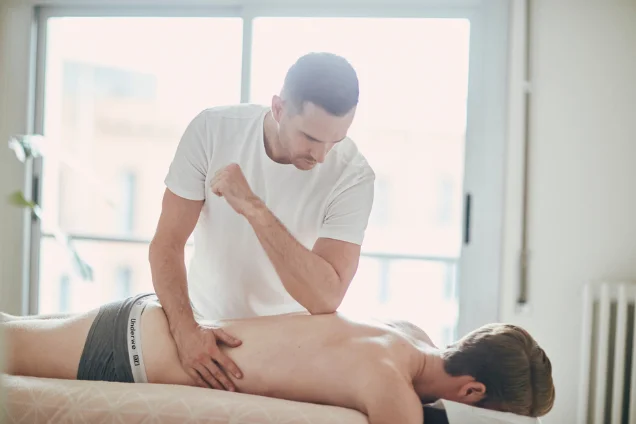
Knowing how to breathe during a deep tissue massage is one of the simplest habits that turns a tough session into a truly productive one. I’m Julien, and for over 10 years I’ve been running Under Pressure Massage Barcelona from my studio in Eixample, with 15+ years of experience behind me. Almost every first-time client who comes in for strong pressure work holds their breath the moment I reach a deep spot. It’s completely instinctive. But it quietly works against the session. The good news is that the fix takes about five seconds to learn and stays with you for life.
Why breathing matters when the pressure gets strong
When I work through a tight area, your body has two options. It can either stay soft and let my hands reach the layer of muscle where the tension actually lives, or it can brace and resist. The difference between those two outcomes comes down almost entirely to how you’re breathing.
Holding the breath is the body’s way of saying “get ready, something is coming.” Muscles contract. The ribcage locks up. The shoulders pull in. And suddenly the exact spot I’m trying to reach has turned into a fortress. Steady breathing does the opposite. It signals that you’re safe, that you can let the pressure in and that your body has no reason to defend itself.
After 11+ years of working with athletes, desk workers and tourists across Barcelona, I can tell you this: the clients who breathe well consistently get more from their sessions than the ones who grip the table.
The breathing technique I teach clients
The method is as simple as it gets. Inhale slowly through the nose. Exhale slowly through the mouth. That’s it.
Here’s how I coach it in my studio:
- Slow inhale through the nose, roughly four seconds. Let the belly rise before the chest.
- Slow exhale through the mouth, roughly six seconds. Let the jaw soften and the shoulders drop.
- Line up the exhale with any moment of deeper pressure.
- Keep it unhurried. No counting required. Just steady and slow.
The exhale is the part that matters most. When you breathe out, the body eases, the muscles lengthen slightly and the pressure that felt sharp a moment ago becomes workable. I tell my clients often: if a spot feels intense, slow the exhale. Never stop the breath. Slow it.
What happens when you hold your breath
This is the pattern I see with almost every first-time client. We find a tight spot. The pressure builds. And without realising it, the breath stops.
What follows is predictable. The muscle I’m working on tightens defensively. The surrounding muscles join in. The body goes into a small brace response. And the session turns into a struggle instead of a release.
This isn’t about toughness. Holding the breath is simply the body’s oldest reflex to something unfamiliar. Once you know the pattern, it’s easy to undo. The second you notice your breath has stopped, take one slow exhale through the mouth. You’ll feel the tension drop within a single breath cycle.
If you’re still deciding whether deep tissue is the right fit for what your body needs, my guide to choosing between deep tissue, Thai and sports massage walks through each option in plain terms.
Using the same technique during a sports massage
Sports massage and deep tissue share a lot of the same territory. Both involve firm pressure, focused work on specific areas and sessions that are intentional rather than relaxing. The breathing guidance is identical.
If you’re in for recovery after a long run along the Barcelona coast, or working through training tightness from the gym, the nose-in, mouth-out rhythm still applies. The only difference I notice is that athletes often breathe well already, because breath control is something they’ve practised during training. That usually makes sports massage sessions flow smoothly from the first minute.
For runners, cyclists and anyone putting their body through regular intensity, the breathwork during the session also helps you carry a calmer rhythm into your next workout.
Extra tips from my Eixample studio
A few small habits make a real difference across a session:
- Take three slow breaths before we start. This sets the tone for the whole session and tells your body it’s fine to relax.
- When a spot feels intense, lengthen the exhale rather than stopping the breath. The instinct is to freeze. The fix is to breathe out longer.
- Tell me when something feels sharp. The pressure is always adjustable, and you’re in charge of the intensity from start to finish.
- After the session, stay on the table for a minute. Keep breathing slowly through the nose before you sit up. It helps the body settle into the work.
- If you find yourself gripping the table, let go and slow the breath. Relaxed hands usually follow a relaxed breath.
These small habits turn a session from something you endure into something your body actively receives.
One last thing
Breathing during a deep tissue massage is the single habit that lets you get full value from every session. The pressure is still firm. The work is still focused. But the experience shifts from enduring the intensity to moving through it with ease.
If you’ve been putting off a strong massage because you thought it would be too much, breathe well and you’ll find the session meets you exactly where you need it to. And if you’re thinking about how often to book regular sessions, my guide on massage frequency for active people lays out a simple schedule.
Frequently asked questions
Why is breathing important during a deep tissue massage?
Breathing keeps the muscles soft so I can reach the layer where the tension actually lives. When the breath stops, the body braces and the pressure becomes harder to work through. Steady breathing lets you receive the session instead of resisting it.
How should I breathe during a strong massage?
Slow inhale through the nose for about four seconds. Slow exhale through the mouth for about six seconds. Line the exhale up with any moment of deeper pressure. Keep it unhurried and natural.
What happens if I hold my breath during a deep tissue massage?
The muscles tighten defensively, the ribcage locks up and the body goes into a mild brace response. The session feels harder than it needs to. The moment you notice, take one slow exhale through the mouth and the tension drops within one breath cycle.
Does breathing help with muscle tightness during a massage?
Yes. Long slow exhales help the muscles lengthen and stay soft under pressure. It’s one of the most practical things you can do to get more out of every session.
Should I breathe the same way during a sports massage?
The guidance is identical. Nose in, mouth out, slow and steady, with the exhale matched to deeper pressure. Athletes often do this naturally because breath control is part of their training.
Can breathing make a massage feel less intense?
Yes. When you lengthen the exhale during a deep moment, the body eases and the pressure becomes easier to stay with. Same technique, same pressure, noticeably smoother experience.
Ready to put this into practice?
Book a deep tissue or sports massage session at my Eixample studio. Real-time availability, 24/7 online booking, sessions designed around what your body actually needs.