How Barcelona’s fitness community uses sports massage to maximize training results, prevent injury, and accelerate recovery
The missing piece in your training program
You’re training consistently. You’ve got your nutrition dialed in. You’re following a structured program from a qualified personal trainer. But you’re still dealing with chronic tightness, nagging pain, and slower progress than you’d like.
Here’s what most athletes in Barcelona miss: training breaks down muscle tissue, but recovery builds it back stronger. Without proper recovery protocols, you’re training hard but leaving gains on the table.
The solution? Combining your strength training with regular sports massage in Barcelona. Here’s why this combination is essential for anyone serious about their fitness goals.
The science: Why your muscles need both stimulus and recovery
When you train, whether it’s strength work, hypertrophy training, or mobility exercises, you create microscopic tears in muscle fibers. This is normal and necessary for adaptation. Your body responds by repairing these fibers stronger than before.
But here’s the problem: intense training also creates adhesions, trigger points, and fascial restrictions that limit your recovery and mobility.
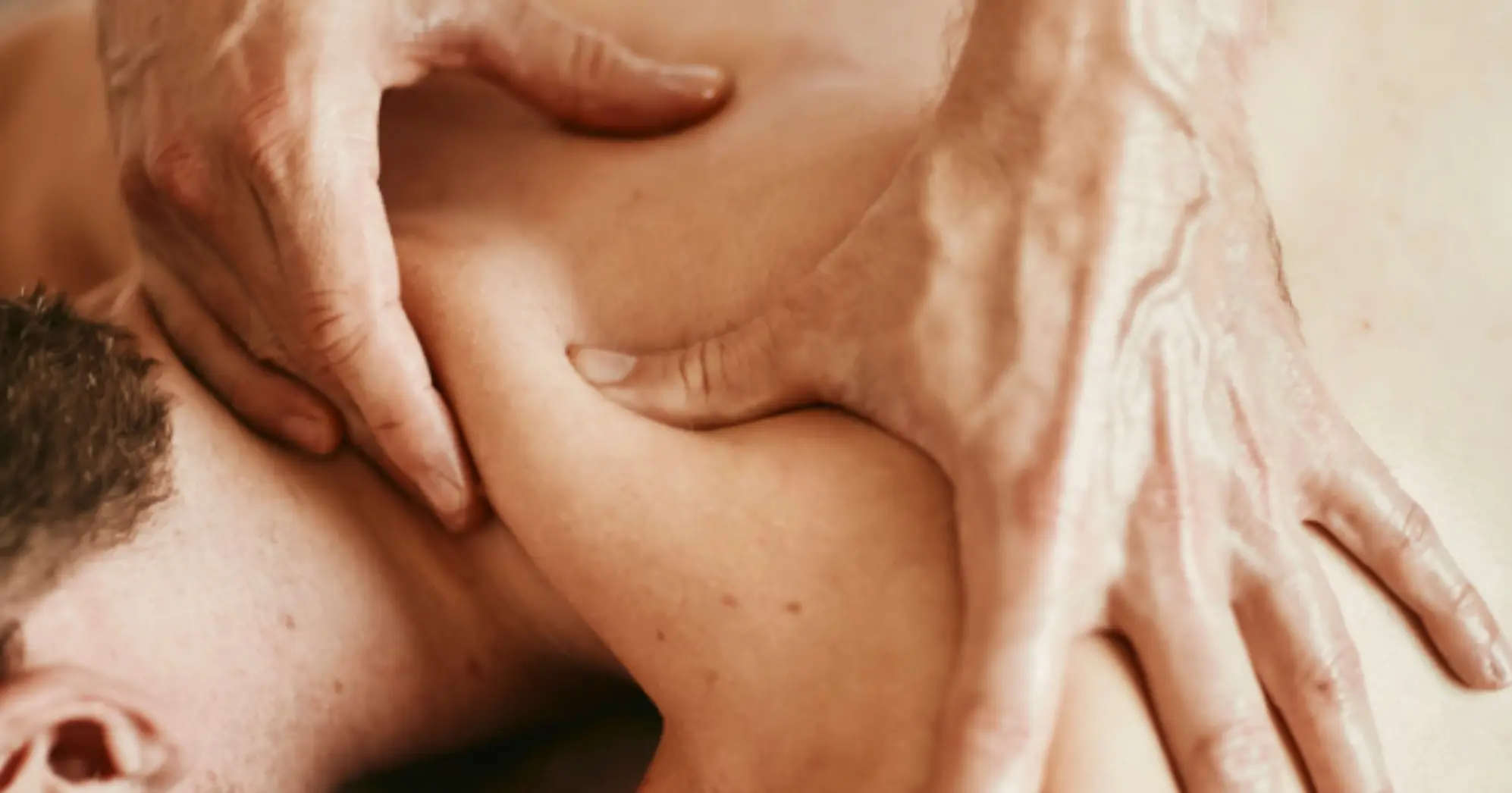
Sports massage addresses these issues through:
- Myofascial release: Breaking up adhesions that restrict movement
- Improved circulation: Delivering oxygen and nutrients to recovering muscles
- Reduced inflammation: Accelerating the removal of metabolic waste products
- Nervous system regulation: Balancing the stress response from intense training
Research shows that athletes who incorporate regular massage experience:
- 30% faster recovery between training sessions
- Reduced delayed onset muscle soreness (DOMS)
- Improved range of motion and flexibility
- Lower injury rates from overtraining
Think of it this way: training is the stimulus, but massage is the catalyst that helps your body actually adapt to that stimulus.
The posture problem: Why core and back work requires massage support
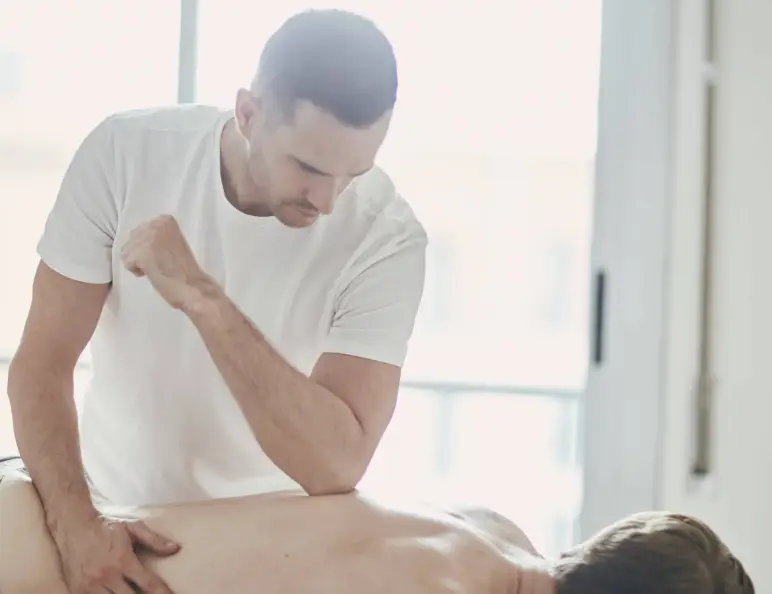
One of the most common issues I see in Barcelona’s training community is lower back pain, even among people doing «everything right» with their programming.
The culprit? Postural compensation patterns that training alone can’t fix.
Here’s what happens:
When you sit at a desk for 8+ hours, certain muscles become chronically shortened and overactive (hip flexors, chest, upper traps), while others become weak and underactive (glutes, deep core stabilizers, mid-back).
You start training to fix this. You do deadlifts, squats, and core work. But your body compensates using the wrong muscles because the fascia and muscle tissue are stuck in dysfunctional patterns.
Result: Your lower back takes over the work that should be distributed across your core and glutes. You get stronger, but the compensation pattern remains, or worsens.
The solution:
Strategic sports massage releases these restrictions, allowing your training to actually reinforce proper movement patterns. When I work with clients who train with postural correction specialists like Martin Ebner, we coordinate our approach:
- Massage releases: the shortened, overactive muscles (hip flexors, chest, upper traps)
- Training activates: the weak, underactive muscles (glutes, deep core, mid-back)
- Movement patterns improve: because the body can finally recruit the right muscles
This is why athletes working with experienced trainers often see breakthrough results when they add regular massage, the training can finally work the way it’s supposed to.
Training types that benefit most from sports massage
Strength and hypertrophy training
If you’re training for muscle growth or maximal strength, you’re working at high intensities with heavy loads. This creates significant muscular tension and can lead to chronic tightness that limits your performance.
Deep tissue and sports massage helps by:
- Reducing excessive muscle tone that limits strength output
- Improving muscle fiber recruitment patterns
- Accelerating recovery between heavy training sessions
- Preventing compensation patterns from developing
I work regularly with strength-focused trainers in Barcelona who understand this connection. When their clients add bi-weekly massage sessions, they typically see better progression on their main lifts and fewer setbacks from tweaks and strains.
Mobility and flexibility training
Mobility specialists focus on expanding your movement capacity through targeted exercises. But fascial restrictions often limit how much progress you can make through movement alone.
Sports massage complements mobility training by:
- Releasing fascial adhesions that restrict joint movement
- Addressing muscle imbalances that pull joints out of optimal position
- Improving proprioception (your body’s spatial awareness)
- Supporting functional movement patterns
The trainers I work with who specialize in mobility and efficient movement often recommend massage as an essential part of their clients’ programs, it’s not optional for serious results.
Online training programs
Barcelona has a growing community of people following online training programs, particularly in the Spanish-speaking fitness community. These programs offer excellent structure and guidance, but they can’t physically address the tissue quality issues that develop during training.
If you’re following an online program, regular massage becomes even more important because:
- You don’t have an in-person coach spotting compensation patterns
- Self-recovery techniques have limitations
- Progressive overload requires progressive recovery strategies
Whether you’re following a Spanish-language online program or working remotely with an international coach, adding local massage support ensures your body can handle the training load.
Sport-specific training
Athletes training for specific sports, cycling, running, CrossFit, climbing, develop predictable patterns of muscular tension based on their sport’s demands.
Sports massage tailored to your specific activity helps:
- Address sport-specific imbalances before they become injuries
- Maintain optimal muscle length-tension relationships
- Support performance during competition phases
- Accelerate recovery during high-volume training blocks
What to expect: Integrating training and massage
If you’re new to combining these approaches, here’s what typically works best:
Timing and frequency
For General Fitness and Strength Training:
- One 60-90 minute sports massage every 1-2 weeks
- Schedule 24-48 hours after your hardest training session
- Avoid deep work immediately before max effort days
For Athletes in Hard Training Phases:
- Weekly sessions during high-volume periods
- Bi-weekly during maintenance phases
- Increase frequency leading into competitions
What results look like
Week 1-2: Improved mobility, reduced general soreness, better recovery between sessions
Week 4-6: Noticeable improvement in movement patterns, fewer compensation issues, training feels more efficient
Week 8-12: Significant reduction in chronic pain or tightness, ability to train harder without setbacks, measurable performance improvements
Most clients tell me they wish they’d started combining these approaches years earlier, the difference in how training feels is substantial.
The Barcelona advantage: A collaborative fitness community
One of the unique aspects of Barcelona’s fitness scene is the strong network of professionals who work together for clients’ benefit. As a professional massage therapist in Barcelona who’s been working for over 10+ years, I’ve built relationships with some of the city’s best personal trainers across different specializations.
This collaborative approach means:
- Your trainer and massage practitioner can coordinate on your specific needs
- We share insights about your movement patterns and restrictions
- You get truly integrated support rather than disconnected services
- Cross-referrals ensure you’re working with qualified professionals
Whether you’re training in English, Spanish, French, or Catalan, Barcelona’s fitness community offers incredible resources for anyone committed to their health and performance.
Ready to experience the difference?
If you’re training consistently but dealing with chronic tightness, slow recovery, or nagging issues that won’t resolve, it’s time to add the missing piece to your program.
I specialize in sports massage, deep tissue work, and techniques that complement serious training. With over 10 years of experience working with Barcelona’s fitness community, I understand how to support your training goals, not just provide relaxation.
My approach includes:
- Assessment of your movement patterns and training demands
- Targeted work on restrictions limiting your performance
- Coordination with your trainer when beneficial
- Practical recovery strategies between sessions
Book Your Session
- Monday, Wednesday, Thursday, Friday: 11:30am – 10:00pm
- Tuesday: 13:30pm – 10:00pm
- Alternate weekends (check online availability)
All sessions are one-on-one in my Eixample neighborhood location.
Location: Ronda de la Univ., 7, 5-1, Eixample, 08007 Barcelona
Book online 24/7: Your real-time availability
Questions? WhatsApp: +34 675 40 79 33
Frequently asked questions
Q: How soon after training should I get a sports massage?
A: For deep tissue and sports massage work, 24-48 hours after your hardest sessions is ideal. This allows the initial inflammation response to settle while still supporting active recovery.
Q: Will sports massage hurt?
A: Good sports massage should feel like «productive discomfort», you feel the work, but it should never be unbearable. I adjust pressure based on your tolerance and tissue response.
Q: Can massage replace stretching or mobility work?
A: No, massage and active mobility work are complementary. Massage releases restrictions, but you need movement to reinforce new patterns. Think of massage as creating the opportunity for better movement, not replacing it.
Q: How do I know if I should see a massage specialist or physiotherapist?
A: If you have an acute injury or need rehabilitation from a specific incident, start with a physiotherapist. For chronic tension, recovery support, and performance optimization, sports massage is the right choice. When needed, I work alongside physios for comprehensive care.
Q: Do you speak English, Spanish, or other languages?
A: Yes, I work in English, Spanish, French, and Catalan, so we can communicate in whatever language is most comfortable for you.
Under Pressure Massage Barcelona – Professional sports massage supporting Barcelona’s training community with over 10 years of experience.
Ready to train better and recover faster? Book your session now