I’m Julien. I’ve been giving professional massage for over 16 years, the last 11 of them here in Barcelona, and traditional Thai massage is the one technique I trained for in Thailand itself, at TMC Chiang Mai. If you’ve been searching for authentic traditional Thai massage in Barcelona and want to understand what separates the real thing from the spa version that uses the same name, this is the guide for you.
Quick answer Authentic traditional Thai massage in Barcelona means vigorous full-body work along the Sen Sib energy lines, performed fully clothed on a floor mat, by a practitioner trained at a recognised Thai school. I trained at TMC Chiang Mai, the only Thai massage school in Thailand holding Government Certified status from the Ministry of Education, and I run every session personally at my Eixample practice.
What “traditional” actually means in Thai massage
Traditional Thai massage, called Nuad Thai in Thailand, is one of the oldest healing arts in the world. UNESCO added it to the Representative List of the Intangible Cultural Heritage of Humanity in 2019, alongside other living traditions worth protecting. The original form has been practised in Thailand for several centuries, with its roots tied to Wat Pho temple in Bangkok, and is taught today through a small number of recognised schools that preserve the lineage.
Traditional Thai massage is not a relaxation technique. It is a vigorous, full-body system that combines firm pressure along the body’s energy lines with assisted stretching that resembles passive yoga. The recipient remains fully clothed throughout. The practitioner works on a floor mat, using hands, thumbs, elbows, knees and feet to apply pressure, and moves the body through a sequence of positions inherited from generations of teachers.
Three things make a Thai massage genuinely traditional. First, the floor mat. Second, the clothes-on, oil-free format. Third, and most important, the practitioner follows a learned sequence: a structured path through the Sen Sib energy lines and a recognised order of positions, learned from a teacher who learned from a teacher. Skipping the sequence, or improvising freely, produces something that resembles Thai massage but lacks its structure and its effect.
Why TMC Chiang Mai is the credential that matters
TMC Chiang Mai, formally the Thai Massage School of Chiang Mai, is the only Thai massage school in Thailand to have received Government Certified status from the country’s Ministry of Education. The certification was approved by the Chiang Mai Governor Office after inspection by the Education Department and the Public Health Department, and after consultation with senior Thai massage scholars. In practical terms, that means the school’s curriculum has been audited, approved and recognised as preserving the authentic technique to a national standard.
The curriculum is unusually serious. The Foundation of Thai Massage Level 1 covers 160 distinct positions across the whole body, learned in sequence. Levels 2 and 3 add advanced techniques and structured approaches to specific bodily concerns. Anatomy, physiology, pathology and kinesiology lectures are delivered by professors from Chiang Mai University’s Faculty of Medicine, so students understand what is happening underneath the skin while they work the surface. Ethics, contraindications and bio-body mechanics are taught alongside the technique itself.
Most importantly, students train hands-on with senior Thai teachers, every day, for weeks at a time. There is no shortcut. The body learns the rhythms, the weight transfer and the pressure progression through repetition and correction. By the time you complete the curriculum, the sequence is in your hands, not in your head.
This is the training I bring back to Barcelona. When you book a traditional Thai massage with me, you are receiving the same sequence, the same rhythm and the same structure that I learned from Thai teachers in Chiang Mai. The lineage is intact.
How to recognise authentic Thai massage from the spa version
Both styles use the same name, but they offer very different experiences. Here is what to look for if you want the genuine, traditional version.
The setting
Authentic Thai massage is performed on a floor mat, with you fully clothed in loose, comfortable wear. The spa version is often performed on a massage table, sometimes with oils and partial clothing. The floor mat is the format the technique was designed for, because many of the stretches and pressure positions need space and angles that a table cannot offer.
The rhythm
Authentic Thai massage follows a slow, deliberate rhythm. Pressure builds, holds, releases. Stretches are entered gradually and held with full body weight where appropriate. A practitioner who rushes, or who improvises freely from one area to another, is working outside the traditional sequence.
The pressure
Expect firm pressure throughout. Authentic Thai massage uses thumbs, elbows, knees and feet, not just hands, and applies the practitioner’s own body weight strategically. If the pressure feels light or skin-deep, the technique is closer to spa relaxation than to Nuad Thai.
The duration
Traditional Thai massage takes time. A full sequence covers head to feet and back up, working both sides of the body and following the Sen lines. Sixty minutes is the practical minimum for a focused session. Ninety or one hundred and twenty minutes is where a full traditional sequence becomes possible. Anything significantly shorter is a sample, not a full session. The session lengths and what each one covers are listed on my Thai massage service page.
The training
Ask where the person trained. A practitioner who studied at a recognised Thai school will tell you the school name, the years of training, and what their curriculum included. My background and training is documented openly for anyone who wants to verify the path before booking.
What your body experiences in an authentic session with me
Here is the rhythm of a traditional Thai massage session at my practice in Eixample.
Arrival and brief consultation.
We take a few minutes to talk about your body, your flexibility, any areas of tension and anything you’d prefer me to avoid. You change into loose, comfortable clothing. I provide shorts and a t-shirt if you’d prefer that to bringing your own.
Opening the session.
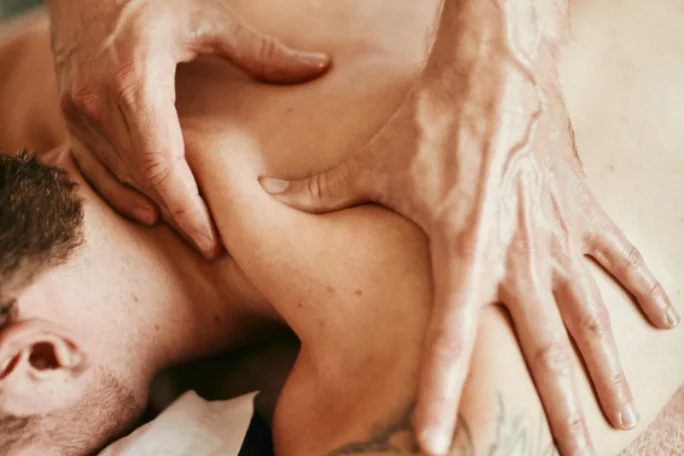
The session begins with the shoulders and neck. The first ten to fifteen minutes are focused on firm compressions and progressive stretches that warm your muscles, release upper-body tension, and prepare your body for deeper work. This is also when I learn how your body responds to pressure, which guides the rest of the session.
Working the Sen lines.
Traditional Thai massage works along ten energy lines known as the Sen Sib, mapped across the body like a network of channels. I apply rhythmic pressure along these lines using thumbs, palms, elbows and sometimes feet, moving systematically from one part of the body to the next. The pressure is firm. The rhythm is steady. The pace is deliberate.
Assisted stretching.
Through the session, I move your body through a sequence of stretches that resemble assisted yoga positions. Hips, hamstrings, shoulders, back, neck. You stay passive, and I do the work. The result is a range of motion you can rarely reach on your own.
Closing the session.
The session ends at the head, with quieter, grounding work. You’ll typically feel awake, alert and energised afterwards, not sleepy. This is the opposite of how a relaxation massage finishes. The traditional Thai effect is more like the aftermath of a strong yoga class than a nap.
Who traditional Thai massage suits, and who might choose something else
Authentic traditional Thai massage is for people who want vigorous, intensive bodywork and are comfortable being moved through assisted stretches. It suits:
- People who feel stuck in their flexibility and want to work it open through a structured, full-body approach.
- People who enjoy strong pressure and want to feel worked thoroughly, not just lightly touched.
- Athletes and active people looking to add deep stretching to their training. The assisted positions reach deeper than most can reach alone.
- Office workers and desk-bound people whose hips, hamstrings and lower backs have grown tight. The Sen-line work and the leg stretches counter that pattern directly.
- Curious travellers and Barcelona residents who want to experience the real version of a technique they may have only met in the spa form. If you are visiting the city, my traveller’s guide to massage in Barcelona covers timing, location and what to expect across all styles.
If you have come to Barcelona looking for a quiet hour of oil-based, candle-lit work, my relaxation massage will suit you better. If your focus is on targeted muscle work rather than full-body stretching, deep tissue massage or sports massage is the closer fit. Traditional Thai massage is a different experience and rewards a different kind of energy when you arrive.
Session lengths and how to choose
My traditional Thai massage runs in three lengths, all built around what the technique actually needs.
- Sixty minutes. A focused session covering two muscle group regions, such as full legs and glutes, or back, shoulders and neck. Good for someone returning who knows what they want addressed.
- Ninety minutes. A full lower-body or full upper-body sequence with time for the Sen lines on either side. This is my most-booked Thai length, since it gives the technique room to breathe.
- One hundred and twenty minutes. The full traditional sequence, head to feet and back up, both sides, along all ten Sen lines. The complete experience and the closest to how I learned to deliver it in Chiang Mai.
Pricing for each length is on my live booking calendar, shown in your local currency, so you can pick what fits your time and budget.
Preparing for your session
A few practical notes that make traditional Thai massage land better.
- Preferably keep meals light in the hour or two before your session. The stretches reach deep into the abdomen and hips, and a full stomach sits awkwardly during that work.
- Hydrate well before and after. The Sen-line work and the stretches both move fluid through the body, and you’ll feel the difference the next day if you’ve taken on water either side.
- Wear or bring loose clothing you can move freely in. Yoga or athletic wear is ideal. I provide shorts and a t-shirt if you’d rather travel light.
- Arrive a few minutes early so you can change unhurried. The session lands better when you settle in calm.
- Each session is individual and indivisible. Couples are welcome and book two separate, full-length sessions back-to-back, so both of you receive a complete experience with me personally.
My Chiang Mai story, in one paragraph
I travelled to Chiang Mai because I wanted to learn traditional Thai massage from the source. TMC Chiang Mai was the school I kept seeing in serious massage circles, the one with the Government Certified curriculum and the long lineage of teachers. The training was uncompromising. The mornings began with Wai Khru, the ceremonial bow to teachers past and present. Long days on the mat, dozens of positions to memorise each week, anatomy lectures from medical professors at Chiang Mai University, and the kind of patient correction from senior Thai teachers that only happens when the school cares more about the technique than about the calendar. The hands you trust to move your body are the hands of someone who has done thousands of repetitions under that kind of correction. I came back changed. The traditional Thai massage I offer in Barcelona is what they trained me to deliver, and I have kept refining it through every session I have given since.
Frequently asked questions about traditional Thai massage in Barcelona
Is traditional Thai massage really from Thailand?
Yes. Traditional Thai massage, called Nuad Thai, has been practised in Thailand for several centuries, with roots tied to Wat Pho temple in Bangkok. UNESCO added it to the Representative List of the Intangible Cultural Heritage of Humanity in 2019, recognising it as a living tradition worth protecting.
What’s the difference between therapeutic Thai massage and spa Thai massage?
Therapeutic Thai massage follows a learned sequence along the Sen Sib energy lines, performed on a floor mat with the recipient fully clothed, by a practitioner trained in a recognised Thai school. Spa Thai massage often focuses more on relaxation, sometimes on a massage table, sometimes with oils. Both can feel pleasant. Therapeutic Thai massage delivers the full traditional experience with greater focus on physical results.
What is TMC Chiang Mai?
TMC Chiang Mai, formally the Thai Massage School of Chiang Mai, is the only Thai massage school in Thailand to hold Government Certified status from the Ministry of Education. Its curriculum is taught in sequence across multiple levels, with anatomy and physiology lectures delivered by professors from Chiang Mai University’s Faculty of Medicine.
Do I need to be flexible for traditional Thai massage?
Flexibility helps but isn’t required. I work within your current range and guide you towards a slightly wider one. The technique is designed to improve flexibility over time, so beginners are welcome. Expect to feel stretched and worked. Productively challenged is the goal.
Is traditional Thai massage painful?
It is firm and intensive. You’ll feel strong sensations in tight areas, similar to the depth of a serious yoga class. I adjust the pressure based on what your body is telling me, and I check in throughout. Most clients describe it as challenging but manageable, and walk out feeling worked rather than sore.
What are the Sen Sib energy lines?
The Sen Sib are ten energy lines mapped across the body in traditional Thai medicine, similar in concept to the meridians of Chinese medicine. Authentic Thai massage works systematically along these lines using rhythmic pressure, which is part of why the rhythm and the order matter so much in a traditional session.
How long should my first Thai massage be?
Ninety minutes is the right length for a first traditional Thai session. It’s long enough to cover the body properly with time to settle into the rhythm. Sixty minutes works as a focused taste. One hundred and twenty minutes gives you the complete traditional sequence on both sides.
Do I have to undress for traditional Thai massage?
No. Traditional Thai massage is performed fully clothed, on a floor mat, with no oils. I provide loose shorts and a t-shirt if you’d prefer them to your own clothing.
Where in Barcelona is your practice?
Ronda de la Universitat 7, 5-1, in Eixample. Five minutes on foot from Plaça Catalunya, ten minutes from the top of Las Ramblas. The 5th floor, door 1. Full directions on my contact page.
Can I book in English?
Yes. The booking system runs in English, and I speak English, Spanish, French and Catalan in the room.
Ready to experience authentic traditional Thai massage in Barcelona?
If you have been searching for the real thing, you have found it. Pick a session length that suits your schedule, book your slot on the live calendar, and arrive ready to be worked thoroughly.
I will be here in Eixample, on the 5th floor, door 1.