
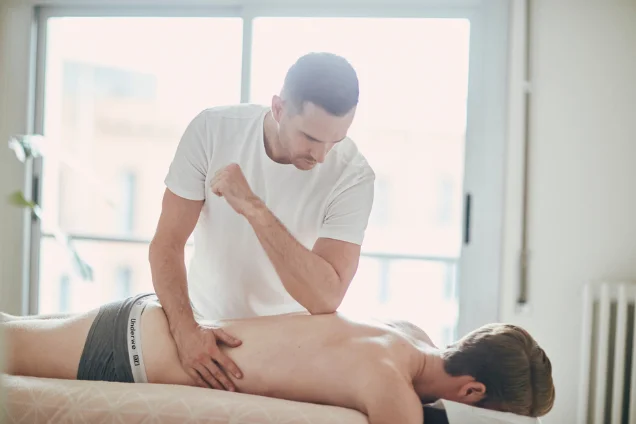
I’m Julien. I’ve been giving professional massage for over 16 years, the last 11 of them here in Barcelona, and the question I’m asked most often by first-time deep tissue massage clients is some version of: “Is it going to hurt?” Honest answer is below.
| Quick answer Deep tissue massage can be intense and you may feel productive discomfort, but it shouldn’t cause sharp, sustained pain. There’s a clear difference between the productive intensity that means the work is landing and the bad pain that signals your body needs me to back off. This guide walks you through both, how to tell them apart in the room, and what to expect before, during and after a session. |
In this guide
- What deep tissue massage actually is
- The honest answer to the hurt question
- Good pain vs bad pain
- Before the session — what to expect
- During the session — the intensity arc
- After the session — the soreness window
- Communication in the room
- Pain by body area
- Who deep tissue suits, and who might choose something else
- Frequently asked questions
What deep tissue massage actually is
Deep tissue massage is firm-pressure, slow-paced work that reaches the layers of muscle and connective tissue beneath the surface. The pressure is deliberate. The pace is unhurried. Forearms, elbows, knuckles and palms do most of the work, with body weight applied strategically to reach depth. This is different from a brisk, light-touch massage that glides across the surface, and different from a sports massage that focuses on athletic recovery patterns.
If you have been searching for “real” deep tissue or wondering what separates it from gentler styles, the difference is in the pace, the depth and the intent. Deep tissue is about reaching into held tension and working it through. My deep tissue service in Barcelona is exactly this style, delivered as a one-to-one session.
The honest answer to the hurt question
Yes, deep tissue massage can be intense. You will feel pressure. In tight areas, you will feel strong sensation. Some of it will be uncomfortable, briefly. That is the work landing.
And: it should be tolerable. It should be the kind of intensity you can breathe through. It should produce sensation that fades quickly once the pressure releases. It should feel like something useful is happening in your body.
What it shouldn’t be is sharp, sustained, panic-inducing pain. The kind of pain that makes you clench your whole body, hold your breath, or want to leave the room. That kind of pain is your body signalling “too much” or “wrong spot”, and the right response is to adjust the pressure rather than push through. Deep tissue is firm, intensive work, and the line between productive intensity and bad pain is real and clear once you know what to feel for.
Good pain vs bad pain, in sensory terms
The phrase “good pain” is shorthand for productive intensity. The phrase “bad pain” is shorthand for the body’s stop signal. Both are sensations. Here is how each one tends to feel, from the receiving side.
Productive intensity (the good kind)
- Strong sensation that fades quickly when the pressure releases.
- Often felt deep in muscle bellies, in tight bands, in held tension. The kind of feeling people describe as “hurts so good”.
- You can breathe through it. Your breath stays available.
- Sometimes accompanied by spontaneous laughter or a sigh of release when a stuck spot lets go.
- Leaves the area feeling worked, looser, slightly tender, and noticeably different from how it felt before.
Bad pain (the stop signal)
- Sharp, electric, burning, or radiating sensation.
- Persists or grows after the pressure releases.
- Felt in joints, bones or nerve lines rather than in soft muscle tissue.
- Forces you to clench, hold your breath, or pull away. Your body tightens against the pressure rather than softening into it.
- Lingers as a wrong-feeling soreness afterwards, instead of the worked-out tenderness of productive intensity.
The simplest test: can you breathe through it? If yes, the work is landing productively. If no, that’s the moment to speak up, and I’ll adjust immediately.
Before the session – what to expect
Most of the anxiety about deep tissue happens before the door even opens. Knowing the structure of the first few minutes takes most of that away.
The intake conversation.
When you arrive, you’ll tell me where the tension is sitting, what brought you in, any injury history, and anything you’d like me to avoid. This isn’t a long medical form. It’s a quick, practical map of your body so I can plan the session around what you actually need.
Setting your pressure ceiling.
Early in the session, when I start working, I’ll calibrate to your body. I’ll begin with medium pressure on a non-sensitive area (often the back or shoulders) and ask you to give me feedback. “More” means deeper. “That’s right” means hold here. “Ease off” means lighter. This conversation lasts about thirty seconds and sets the ceiling for the rest of the session.
Comfort logistics.
Loose-fitting clothes are fine to bring or wear. The room is warm. The table is heated in cooler months. There is water available throughout. Preferably arrive a few minutes early so you can settle in unhurried.
During the session – the intensity arc
Every deep tissue session I give follows the same general arc. The intensity is shaped throughout, building and easing in stages.
Warm-up phase (first 10 to 15 minutes).
I begin with lighter pressure, working broad strokes across the back, shoulders and limbs to prepare the muscles. Going straight to deep work on cold muscles produces defensive tightening, which makes the rest of the session harder. The warm-up isn’t filler. It’s the foundation.
Deep work phase (the middle).
This is where the intensity sits. I focus on the areas you flagged in the intake, working layer by layer into held tension. Breathing through this phase makes a real difference and I’ll cue you on it if I see you holding your breath. Pressure builds, holds, releases. The pace stays unhurried. I check in throughout, sometimes verbally, sometimes by watching your breath and your body language.
Settling phase (last 10 to 15 minutes).
I lighten the pressure gradually, ending with calmer, flowing strokes that signal your nervous system the work is done. You shouldn’t get up from intense pressure and walk straight out. The wind-down matters.
After the session – the soreness window
Knowing what’s normal afterwards prevents the second wave of pain anxiety, which is the “did I do something to my body?” worry that some people have for a day or two after their first deep tissue session.
The first few hours.
Most clients feel lighter, looser, and a bit spaced out for the rest of the day. Some feel quite energised. Some feel sleepy. Both are normal responses, depending on your nervous system.
The next 24 to 48 hours.
This is the soreness window. You may feel tender in the areas that were worked, similar to how you’d feel the day after a strong workout. This isn’t injury soreness. It’s the feeling of muscles that were under sustained pressure and are now adjusting. The tenderness fades over a day or two and is usually replaced by a noticeable looseness in the area that was worked.
What helps.
- Hydrate well for the rest of the day and the day after. The work moves fluid through the body and you’ll feel the difference if you’ve taken on water either side.
- Move gently. A walk, light stretching, an unhurried morning. Avoid intense training the day of your session.
- Warmth helps if soreness is present. A warm shower or bath the next morning eases lingering tenderness.
- Sleep tends to be deeper than usual the night of a session. Plan for an early night if you can.
When soreness signals something else.
If soreness sharpens rather than fades over the second day, or if you feel pain in joints, bones, or along a nerve line, that’s worth flagging. Sensible response: rest, message me, and adjust the next session accordingly. This is uncommon when pressure has been calibrated correctly in the room.
Communication in the room
This is the single most important section of the guide. Deep tissue done well is collaboration, and good collaboration depends on clear, fast feedback from both sides.
What you can say, any time.
- “Ease off.” Quick, clear, no explanation needed.
- “Less pressure here.” Localised, useful.
- “That’s the spot.” Tells me to stay and work through it.
- “Move slightly higher” or “slightly lower.” Helps me find the exact area.
- “I need a moment.” If something feels overwhelming, I pause.
What I read on your side.
Even if you say nothing, I’m watching for breath holding, micro-tension in your shoulders, fidgeting feet, or jaw clenching. These are the body language signals that say the pressure has gone past productive into bad pain. I’ll back off when I see them, and ask you what you’re feeling.
There’s no toughness award.
Some people grew up with the idea that the right thing to do during a massage is grit your teeth and absorb whatever the massage giver brings. That approach makes the session worse. Productive pressure depends on a body that’s softened into the work, and a clenched body softens for nothing. Speaking up makes the session better and lands the work more cleanly. I’d rather know in real time than have you leave feeling bruised.
Pain by body area
Some areas tend to be more intense than others in a deep tissue session. Here’s a rough map of where most clients feel the strongest sensation, and why.
Neck and upper traps.
Often the most intense area because most people hold significant tension here from screens, posture and stress. I work this area slowly, with smaller pressure increments and frequent check-ins. The neck rewards patience and punishes rushing.
Shoulders and rotator cuff.
Surprisingly tight in most people, including those who don’t think of themselves as tense. Deep work into the shoulder blade and the rotator cuff area tends to produce strong sensation that fades quickly. This is usually the area where clients say the most in-session “oh” of release.
Lower back.
Lower back work needs careful positioning and steady pressure. Done well, lower back deep tissue is one of the most relieving experiences in massage. Done badly, it’s where people feel sharp pain. I work the lower back with palms and forearms more than elbows, and I check in often.
Glutes and hips.
Most people are surprised by how tight their glutes and hips are. The work here is firm but tends to feel productive rather than sharp, partly because the muscles are large and well-padded. This area often holds tension that the lower back has been compensating for.
Hamstrings and calves.
Calves can be unexpectedly intense, especially for runners and desk-bound clients. Hamstrings tend to feel like a productive deep stretch under pressure. Communication helps me find the line between deep work and overworking.
Feet.
If feet are included, expect strong sensation. Foot work is often intense for the first minute and then becomes remarkably pleasant. Some clients ask for more, others prefer to skip feet entirely. Either is fine.
Who deep tissue massage suits, and who might choose something else
Deep tissue is for people who want firm, intensive bodywork that reaches into held tension. It suits:
- People with chronic tightness in specific areas (neck, shoulders, lower back) that gentler styles haven’t shifted.
- Desk workers and screen-heavy professionals carrying tension in the upper body.
- Active people who feel locked up rather than injured, and want to be worked into mobility.
- Clients who already enjoy strong pressure and want to feel worked rather than touched.
- First-time massage clients who want an honest, communicative experience rather than a silent endurance test. If you are visiting the city and weighing options, my Barcelona traveller’s guide to massage walks through how to choose across styles.
If you are looking for stress release rather than focused muscle work, my relaxation massage will land better. If you are training hard and need recovery-focused work, sports massage is the closer match. And if you want full-body stretching combined with pressure work, traditional Thai massage is its own different experience. Deep tissue is the right choice when held muscle tension is the thing you want to solve.
Frequently asked questions about deep tissue massage and pain
Is deep tissue massage supposed to hurt?
Deep tissue massage can be intense and you may feel productive discomfort, but it shouldn’t cause sharp or sustained pain. The work should feel strong, breathable, useful and always within what you can handle calmly.
How sore should I be the next day?
Mild to moderate soreness, similar to the day after a strong workout, is normal in the areas that were worked. It typically fades within 24 to 48 hours and is replaced by a sense of looseness.
Can deep tissue massage cause bruising?
Light tenderness in worked areas is common. Visible bruising is uncommon and signals the pressure went past productive. Calibrated correctly in the room, deep tissue rarely produces bruising. If bruising shows up after a session with me, I want to know, and the next session adjusts accordingly.
How often should I get deep tissue massage?
For maintenance, every three to four weeks works for most people. If you’re addressing significant chronic tension, weekly or fortnightly sessions for a month help, then taper to maintenance. The right rhythm depends on your body, your activity level, and what you’re working through.
Can I tell you to ease off without offending you?
Always. Speaking up makes the session better and lands the work more cleanly. Phrases like “ease off” or “less here” are exactly the kind of feedback that produces a good session. I’d rather adjust in real time than have you leave feeling overworked.
What if I can’t handle the pressure?
We adjust. Deep tissue isn’t a fixed intensity. I work to the depth your body welcomes today, which may be different from the depth you welcomed last month. Pressure is a conversation, and I’m happy to keep it lighter throughout if that’s what your body wants.
Is deep tissue safe for first-timers?
Yes, with honest communication. First-timers actually tend to have very good sessions because they say more in the room. The clients who struggle are sometimes the experienced ones who think they should silently absorb whatever’s brought to them.
What’s the difference between deep tissue and sports massage?
Deep tissue focuses on chronic tension and held muscle patterns, with a slower pace. Sports massage focuses on athletic recovery and performance, with quicker rhythms and often more specific to event preparation or recovery. They overlap, and a session can blend both, but the intent and pacing differ.
Should I drink water after a deep tissue massage?
Yes. Hydration after deep tissue genuinely helps with the next-day feeling. Aim for an extra litre or so spread across the rest of the day and the morning after.
Where in Barcelona is your practice?
Ronda de la Universitat 7, 5-1, in Eixample. Five minutes on foot from Plaça Catalunya. The 5th floor, door 1. Full directions on my contact page.
Ready for an honest deep tissue massage in Barcelona?
If you have been searching for someone who will work with the right intensity for your body rather than against it, you have found me. Read more about my background and training if you’d like the context before booking, or pick a slot directly below.